
Understanding Printable Size and Margins in Wall Printing
One of the most common questions for muralists and service providers is: "How big can the printer actually print?" While the theoretical capacity is often "unlimited," the practical printable size is defined by the hardware’s physical dimensions and the "dead zones" near corners and edges.
Vertical Height: Fixed vs. Extendable
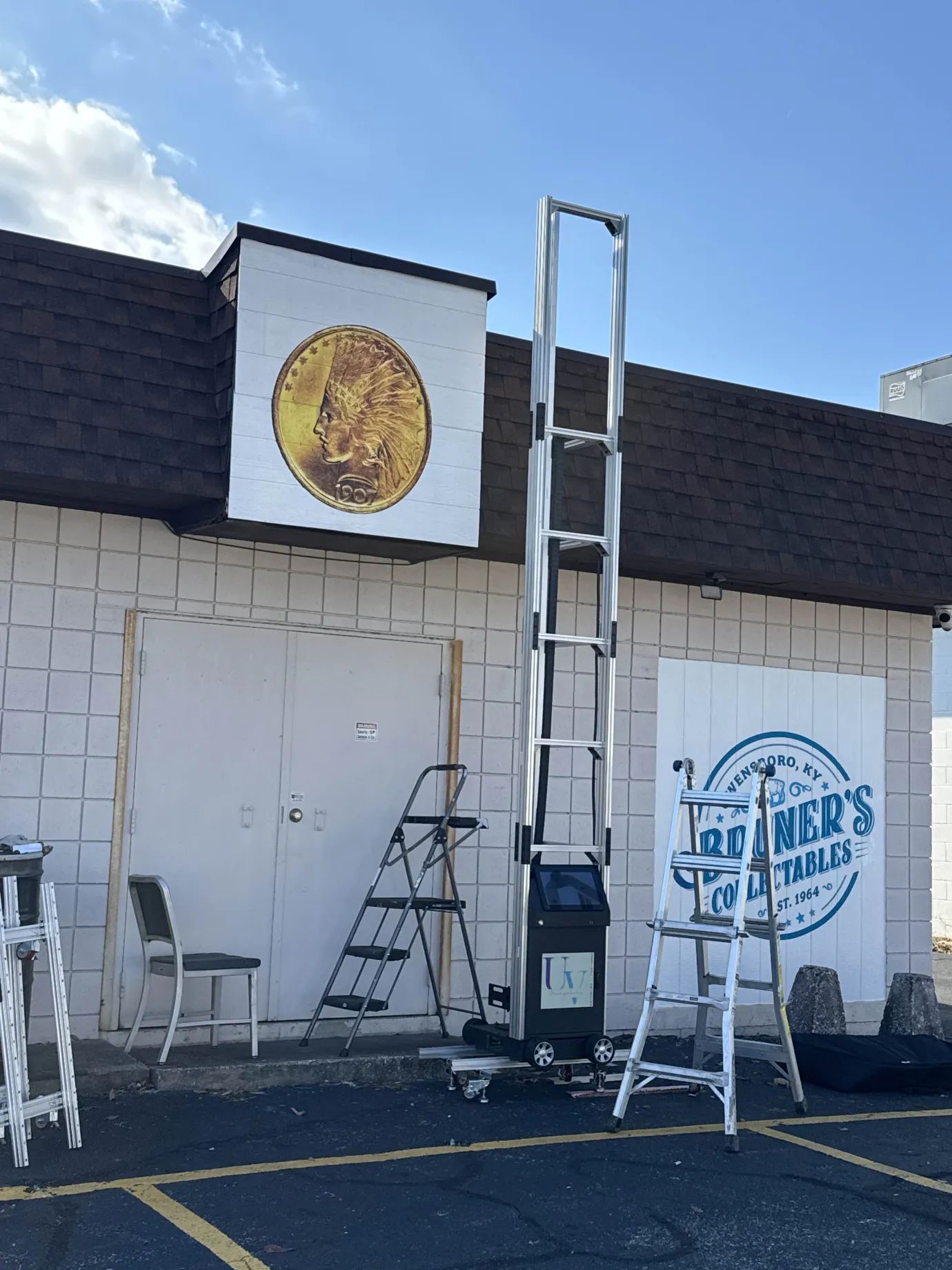
The vertical height of a wall printer is determined by its vertical rails.
-
Standard Height: Most DXonJet printers come with a standard vertical rail allowing for a print height of roughly 2 meters to 2.5 meters.
-
Extension Poles: By adding extension rails, the height can be increased significantly (up to 3.5 or 4 meters).
-
Infinite Height (Stitching): For walls taller than the rails, professionals use a "Stitching" technique. This involves printing the bottom half, then raising the entire machine on a platform to print the top half, using the control software to align the images seamlessly.
Horizontal Width: Virtually Limitless
The horizontal dimension (the X-axis) is where wall printers truly shine.
-
Track-Driven Systems: Since the printer moves along a rail system, you can simply add more tracks to print murals of any width. Whether the wall is 5 meters or 50 meters wide, the printer can traverse the distance in one continuous job.
-
Wheel-Driven Systems: These rely on the floor’s length and the battery/cable reach. Like the track system, the width is essentially only limited by the physical environment.
Understanding "Dead Zones" (Printable Margins)
It is a common misconception that a wall printer can print from "edge to edge" or "floor to ceiling." Due to the physical size of the printhead carriage and the rail system, there are inevitable margins:
-
Bottom Margin: The printhead cannot reach the very bottom of the wall because the carriage sits on a base with wheels or tracks. This usually results in a 20cm to 40cm unprintable area at the bottom.
-
Top Margin: The top rail and the carriage assembly require clearance, leaving a gap of roughly 25cm to 40cm from the ceiling.
-
Side Margins (Left/Right): To protect the printhead and allow for sensor detection, the machine needs a margin of 5cm to 15cm from side walls or corners.
[Diagram Suggestion: A graphic showing a wall with the "Printable Area" highlighted in the center and the "Dead Zones" labeled at the edges.]
Technical Summary: Maximizing Your Workspace
| Dimension | Typical Limit | How to Expand |
| Height | 2m – 4.5m | Use Extension Poles or Vertical Stitching |
| Width | Unlimited | Add more horizontal tracks |
| Floor Gap | 20cm – 40cm | Use a specialized low-profile base or vinyl finishing |
| Ceiling Gap | 25cm – 40cm | Image design planning |
Summary
While the vertical wall printer is the most flexible tool for large-scale murals, successful projects require careful site surveys. Understanding the margins allows you to design your artwork so that no critical elements are lost in the "dead zones" of the wall.

 English
 Español
 Français
 Deutsch
 Italiano
 Nederlands
 Polski
 Русский
 Türkçe
 한국어
 Română
 繁體中文
 العربية
 हिन्दी
 日本語