DXonJet Software Update: Support Auto-Maintenance Program
July 22, 2023
Why DXonJet Wall Printer?
August 20, 2023DXonJet Printer is the first company in China to start designing, researching, and producing vertical wall printers. As of now, we have provided services to more than 500 customers worldwide. DXonJet has published the problems and solutions of vertical wall printers, hoping that other peers can uphold the attitude of being responsible to customers and products, and continuously improve and upgrade vertical wall printers. DXonJet's technical team is also willing to provide technical advice to customers who have wall printers.
Vertical UV wall printers typically use two horizontal driving methods: wheel drive and gear drive on tracks. Wheel drive is favored by users for its convenience in walking on horizontal surfaces, ease of setup, and ability to traverse an infinite width of distance. However, due to its low precision, wheel drive often results in reduced image printing quality and catastrophic consequences.
This article will explain the problems of wheel drive for vertical wall printers and introduce the solution provided by the DXonJet team.
The Mechanism of Wheel Drive And The Reasons for The Formation of Clearance
The principle of wheel driven implementation is: the motor and the reducer drive the wheel shaft together, making it rotate, and then the wheel shaft drives the wheel to rotate, enabling the vertical printer to move.
The function of the reducer is to convert the high-speed rotation of the motor into a larger torque and input it into the machine through the wheel shaft, thereby achieving the effect of driving the machine to rotate, and also having a deceleration effect.
The ordinary vertical wall printer adopts a worm gear reducer as the transmission device, which features a reverse self-locking function and can provide a large reduction ratio when significant deceleration is required.
However, the input shaft and output shaft of this reducer are not on the same axis or the same plane. The volume of this reducer is usually large, and the transmission efficiency and accuracy are not high enough, leading to large motion gaps.
Meanwhile, the accuracy of mechanical design can also have a significant impact on clearances. For example, errors in the fit between the wheel axle and the gearbox, as well as errors in the fit between the wheel axle and the wheel itself, can add to the accuracy error of the worm gear reducer, ultimately resulting in the clearances seen in the video.
It should be noted that this accumulated error can often cause wear and malfunction of mechanical components, so in designing and selecting mechanical components, efforts should be made to minimize the impact of fit errors and reduce the effect of accumulated errors.
This Margin of Error Will Affect The Quality of The Image Print
Due to precision error, the gearbox will automatically lock excessive torque each time. When the self-locking force reaches its peak, it will be released during the next self-locking. This release process will have a serious impact on print quality.
In the video below, many white vertical stripes are likely caused by insufficient accuracy of the gearbox and excessive error between the wheel and the axle.
The Solution Provided by The DXonJet Technical Team
Firstly, let us observe the performance of the VPJet.0 UV vertical wall printer when hand-pushed without electricity.
Under such circumstances, how is the printing effect?

After one month of design and testing by the DXonJet technology team, we finally adopted the following chassis design solution.
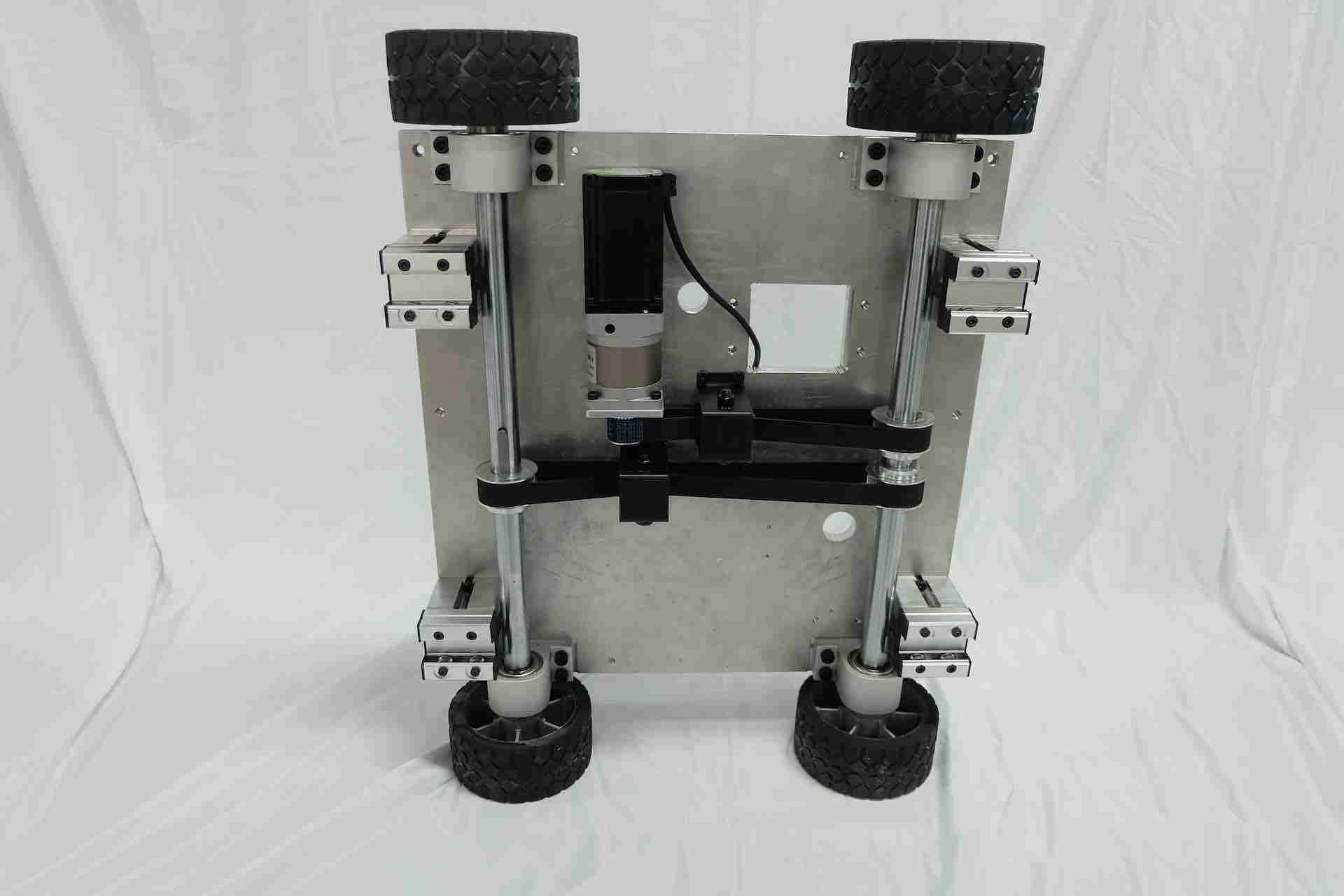
This chassis is constructed with a solid aluminum plate, and equipped with a motor, planetary reducer, axle, wheel, tensioner wheel, and belt, with a weight of 23kg. The structure of this chassis provides stable support for the movement of the entire vertical printer body.
Solution 1: Use Planetary Gearboxes
The DXonJet technical team recommends using planetary gearboxes instead of worm gear reducers. Planetary gearboxes have a compact structure, minimal backlash, high precision, and long service life. They can output large torques.
However, planetary gearboxes are relatively expensive. In order to design a high-quality vertical printer, we have used expensive yet excellent quality components in other aspects.
Solution 2: Use tensioning wheels
A tensioning wheel is an adjusting device used for belt transmission. When the center distance of the belt cannot be adjusted, a tensioning wheel can be used to secure the belt. It is a type of idler wheel that adjusts the wrap angle of the belt pulley or controls the tension force of the belt to achieve belt transmission.
Since belt transmission is based on friction, the belt must be tightened during installation. However, over time, the belt may become loose due to elongation, which can lead to slippage. Therefore, it needs to be retightened.
When the center distance between two transmission wheels cannot be adjusted, a tensioning wheel must be used to ensure smooth transmission without slippage. The tensioning wheel uses forces such as springs or hydraulic pressure to tighten the belt, allowing it to adhere to the working pulley with appropriate pressure.

Solution 3: Adopt Four-Wheel Drive
When driving on different surfaces, the wheels may slip. If a two-wheel drive system is adopted, then the other two wheels will be passive wheels, which can easily cause wheel slippage and adversely affect the image printing quality.
The chassis structure designed by the DXonJet team adopts a four-wheel drive system to ensure that the belt can be fully tightened, and a tensioner design is used.
Solution 4: Precise Design and Processing
By using precise design and processing for mechanical components, they can be tightly connected, thus reducing gaps and errors.
This work is not simple and requires a machining center to continuously refine the polishing of the axle, which increases production cycle and cost.
Finally
We at DXonJet company would like to publicly release the design of our vertical wall printer to all clients and manufacturers, with an open mindset to promote the development of the vertical printing industry. We hope that this will prevent the production of substandard products and enable customers to enjoy high quality vertical printing services.
If you have any questions or technical inquiries regarding vertical wall printers, please feel free to contact us at any time.
Lastly, we wish you all a happy wall printing experience.



 English
 Español
 Français
 Deutsch
 Italiano
 Nederlands
 Polski
 Русский
 Türkçe
 한국어
 Română
 繁體中文
 العربية
 हिन्दी
 日本語