Everything You Need To Know About Dxonjet Wall Printers
July 22, 2026The Brutal Truth About the Wall Printing Business (Don’t Buy a Machine Yet)
🎧 Listen to the Podcast
A lot of people think starting a wall printing business is easy. They think you just buy a machine, plug it in, and the money starts rolling in.
I’ve been in the wall printing industry for over eight years. I’ve worked with more than 1,000 clients. And I can tell you exactly what most beginners think: They think the market is empty. They think the demand is massive. They look at the ROI and think they can just hire someone to run the machine while they sit back and collect passive income.
The Harsh Reality
But here is the harsh reality.
A lot of buyers actively try to sell their machines within the first three months. By month six, the printer is just sitting there gathering dust. Some people literally give up by week two. Why? Because they bought a cheap printer. They quickly realize it can’t deliver decent print quality, it’s entirely unreliable, and they completely lose the confidence to actually go out and pitch their services to clients.
But it’s not just the cheap machines. I also see people desperately trying to offload insanely expensive printers—machines like the wallPen that cost upwards of 50,000 Euros.
When you see this happening, you have to ask yourself: Is this business actually worth the investment? Should you buy an expensive machine? Or should you just buy a cheap one to test the waters?
Calculating Your True ROI
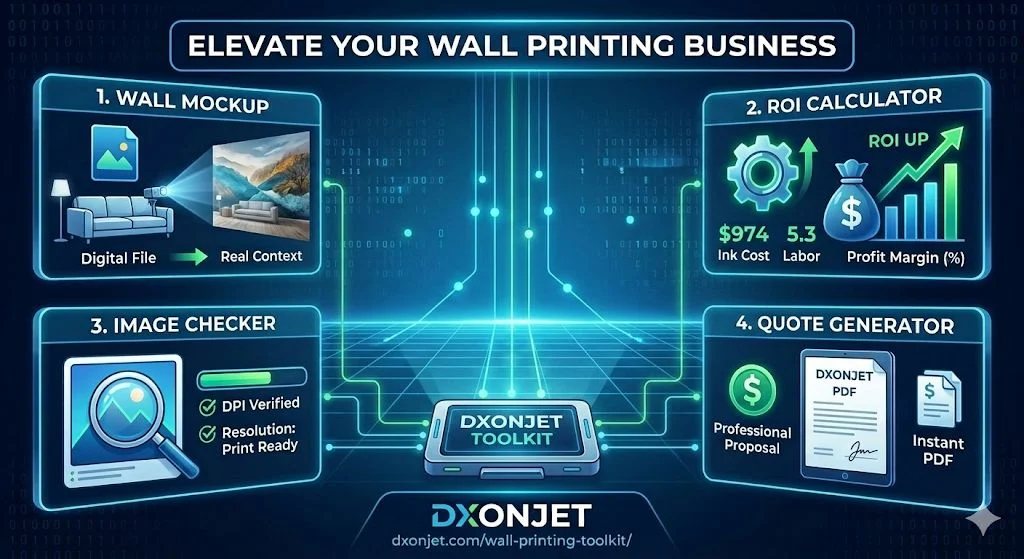
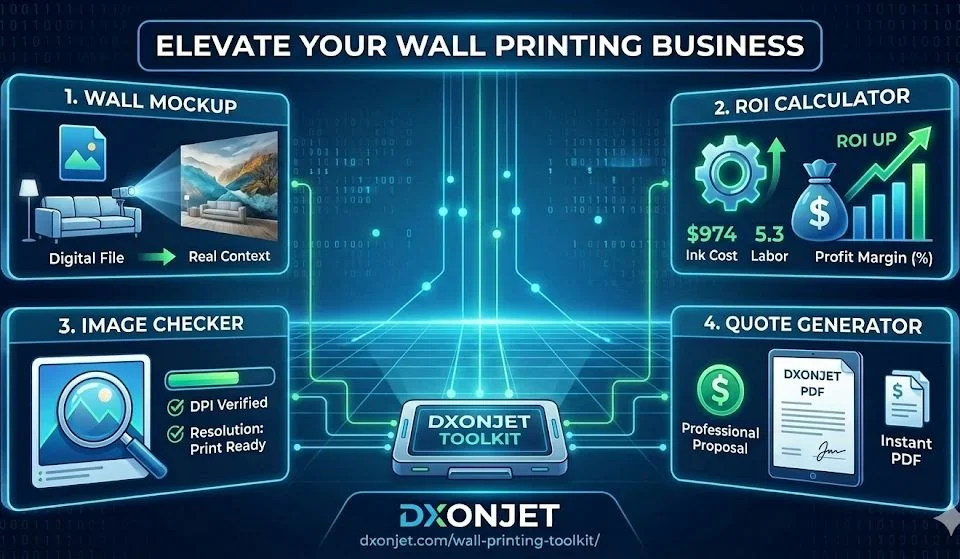
If you want to calculate your exact numbers, there is a very detailed ROI calculator on the DXonjet website. You can figure out exactly how long it will take to make your money back. But I’ll tell you right now, the hardest thing to calculate isn’t the cost of ink—it’s how many jobs you can actually book a month, and how much money you’ll lose when your machine breaks down and costs you a gig.
I’m going to be completely responsible here and tell you the truth: As a beginner, you are not going to have a massive amount of wall printing jobs right out of the gate.
If a supplier tries to sell you a machine by telling you “print speed is money”—do not believe them. You don’t need blazing-fast print speeds. What you actually need is a machine that consistently outputs high-quality images, rarely breaks down, has professional after-sales support, and costs very little to maintain.
The Inevitable Mistakes
As a new user, you are going to make mistakes. It’s inevitable. When that happens, you need a highly professional technical support team that will answer every single one of your “stupid” questions without hesitation. You also need comprehensive, detailed training before you even start. That is the only way to eliminate your blind spots and truly understand your machine.
If you are new to this, you have to accept that the following things will happen to you:
Number one: Print failures.
You will mess up a print, and you will have to repaint the client’s wall out of your own pocket. Please accept this fact right now, or do not enter this industry. There are many reasons a print can fail, but honestly, it’s usually user error and a lack of understanding of how the printing process actually works. Again, this is why training and a support team that tells you everything transparently is non-negotiable.
Number two: Clogged or damaged printheads.
If you use your printer long enough, you will have to replace the printhead. Period. And you never know when that day will come. If a manufacturer promises you the printhead will last two or three years—don’t believe them. Maybe it lasts two years. Maybe it lasts one year. Maybe it dies in six months. No matter what brand of printhead you use, it can clog at any time. It could be ink quality, debris in the ink, or the UV lamp accidentally curing the ink right onto the surface of the nozzle.
Or, it could just be your fault. You make a mistake, the printhead crashes into the wall, the surface breaks, and boom—you have to replace it. The cost of a replacement printhead is a massive factor for beginners. You need to calculate that into your business plan.
How to Keep Your Machine Active
So, what do you do when you don’t have wall printing jobs? How do you keep the machine active?
We have clients who use their wall printers to print on canvas. We have others who partner with e-commerce stores to print on custom luggage. The absolute best way to maintain your printer is to keep it printing. Do not let it sit idle for too long.
Remember, nobody is going to hand you business. You have to hunt for it yourself. Maintaining an active, high-quality social media presence is crucial.
Your biggest clients will always be schools, hospitals, hotels, and museums. You need to build strong local relationships with these institutions. I have a client who only does two jobs a year for two major clients. But each job is over 100 square meters. Because of his specific business model, he only uses $400 printheads. He finishes the massive project, and then he just throws the printhead away.
This is why I always tell my clients: The most expensive printhead is not always the best one. It entirely depends on your business model. You won’t always have wall printing jobs, and most clients won’t have a constant stream of projects.
My Final Advice
So, if you want to get into the wall printing industry, here is my final advice:
I do not recommend buying a cheap printer. You won’t get the training or the tech support you need, and your business will never get off the ground smoothly.
But, I also do not recommend buying an ultra-expensive printer if you don’t already have a lot of large projects lined up. Expensive, high-speed printers usually come with massive maintenance costs, higher operating risks, and a much lower ROI.
Look, I know I’ve said a lot of scary things today. But if I haven’t scared you off, and you’re still genuinely interested in this business, let’s talk.
DXonJet has hundreds of successful clients all over the world. I constantly share their real-world printing videos on my Instagram, so go check that out. If you have questions that are keeping you up at night, reach out. I can answer them.
Thanks for watching. See you in the next one.


 English
 Español
 Français
 Deutsch
 Italiano
 Nederlands
 Polski
 Русский
 Türkçe
 한국어
 Română
 繁體中文
 العربية
 हिन्दी
 日本語